
Home › Hair transplantation
HAIR TRANSPLANTATION
Hair transplantation
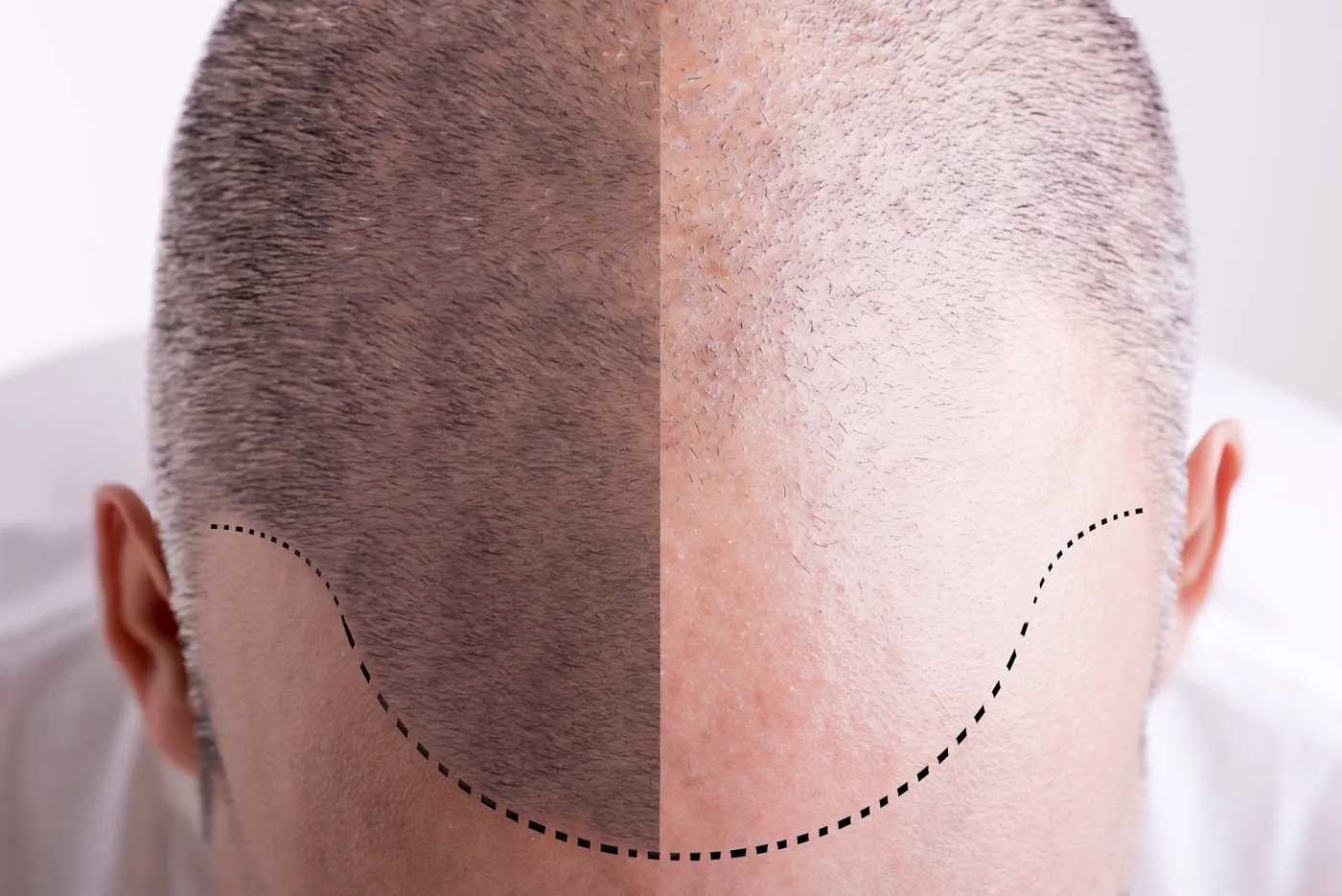
What is commonly called a “hair transplant” is in fact an operation. Hair loss occurs because the hair follicles at the front and top of the head are not resistant to the body’s hormones, while the follicles at the back of the head are more resistant. The basic principle of hair transplantation is to move these resistant follicles from the back of the head to the area of hair loss. Because the transplanted follicles keep the characteristics of the area they were taken from, they are permanent in their new location too.
AnaesthesiaLocal anaesthesia
Procedure timeUsually 1 day
ON THIS PAGE
Who is it for?The four stages of successHow is a natural hairline planned?How is the operation done?PreparationRecovery and new hair growthPossible risksFAQ
Any questions?
Send us your photos and we will discuss the options that may suit you.
Who is it for?
- People with male-pattern hair loss whose hair loss has settled into a stable pattern
- People with enough healthy follicles at the back of the head
- People with hair loss in the eyebrows, beard or a scar
- Women with female-pattern thinning who are found suitable after the cause has been investigated
In sudden and diffuse hair loss, the cause (thyroid, iron deficiency, hormonal causes, stress) must be investigated first; in these cases hair transplantation is not the first treatment.
The four stages of success
Success depends on four stages: harvesting the follicle without damaging it, storing and separating it under suitable conditions, creating channels that match the natural direction of hair growth, and placing the follicles without injuring them. A mistake at any of these steps results in an empty patch.
Good planning, good distribution, correct selection of follicles, a realistic goal, a suitable technique and speed are the conditions for success. — Dr. Tolga Yener
Dr. Tolga Yener
How is a natural hairline planned?
A mature man’s hairline should suit his age and overall appearance; planning the hairline he had as a child or young man is a mistake. Making the front line sparse and the back dense is an error. It is not possible to cover a very large bald area with a small number of follicles. That is why planning takes into account not only today’s hair loss but also future hair loss, and the follicle capacity at the back of the head is used carefully.
How is the operation done?
The procedure is done under local anaesthesia and usually takes one day. The follicles are harvested one by one (FUE) and, for a natural result, placed into needle punctures rather than blade incisions (percutaneous technique). The direction and angle of placement are adjusted to the direction of the natural hair in that area. You go home the same day.
Preparation
- Blood thinners are stopped 1 week before the procedure (after consulting your doctor).
- In patients with diabetes or high blood pressure, values should have been under control for the past week.
- Smoking reduces the success rate; if possible, stop beforehand.
- On the day of the procedure, wear a comfortable top that buttons at the front.
Recovery and new hair growth
| Period | What happens? |
|---|---|
| First days | Redness and crusting in the transplanted area; mild swelling of the forehead may occur |
| First 10–15 days | The crusts come off with washing |
| End of the 1st month | The transplanted hairs fall out; this is expected – the follicles remain in place |
| 2nd month | No new hair yet; this period requires patience |
| Months 3–9 | New hair gradually grows in |
| 12th month | The final result settles within a year |
The first wash and the washing technique are shown at your check-up. In the first weeks, hats and helmets that press on the transplanted area and strenuous exercise are not recommended.
Possible risks
Swelling, redness, itching, temporary pimple-like redness around the follicles, temporary thinning in the donor area (shock loss) and, rarely, infection may occur. Expectations that exceed the follicle capacity at the back of the head are the most common reason for dissatisfaction; that is why a realistic goal is set together at the consultation.
Frequently asked questions about hair transplantation
Will the transplanted hair fall out again?
Because they are taken from the resistant follicles at the back of the head, transplanted hairs are permanent. However, your own hair in areas that were not transplanted may continue to fall out; that is why supportive treatment is recommended for some patients.
How many grafts are transplanted?
The number of grafts is decided at the consultation according to the size of the bald area and the capacity of the donor area. It is not possible to cover a very large bald area with a small number of grafts.
Is hair transplantation done for women?
In women, thinning is usually diffuse, so the cause is investigated first. If there is a high hairline or permanent loss in certain areas, hair transplantation may be suitable.
When can I go back to work?
You can usually return to desk work within a few days; the appearance may attract attention until the crusts have come off.
Does PRP help hair transplantation?
PRP can be used as a supportive treatment for the hair follicles, either together with hair transplantation or on its own. PRP →
Consultation for hair transplantation
Let us decide on the right method for you together at the consultation. If you live outside Istanbul or abroad, we can make a preliminary assessment based on your photos.